Hunting Bullet Metrics
Apply Terminal Performance Truth
Is a Hunting Bullet’s Mushroom Diameter a Valid Metric to Evaluate Wounding?
By Scott Fletcher
“Evaluating a bullet’s mushroom is like judging a woman’s derriere: size and shape accrue no technical merit, only highly subjective style points.” - Scott Fletcher
One primary task of an expanding hunting bullet is to create a wound in a big-game animal’s vital organs that is large enough to produce a quick death. Such bullets are intentionally designed to rapidly deform length-wise upon entering an animal. This deformation transforms its typically-tapered tip into a supersonic bulbous battering ram, as indicated in Photo 1. The transformed tip shape is called a mushroom, and its intent is to crush/rupture/displace tissue cells during the bullet’s penetration through vital organs so they can no longer function. The mushroom’s penetration results in an observable hole though tissue, such as the one through a black wildebeest’s lung that is shown in Photo 2.
The wound volume produced is assumed to be a cylinder, with its diameter corresponding to the mushroom’s average diameter and its length corresponding to the bullet’s penetration length through the vital organ. The shape and diameter of a bullet’s mushroom retained in either test media or an animal is commonly assumed to represent its shape and diameter throughout the bullet’s penetration length.
A symmetric, circular, and large-diameter mushroom on a bullet retained in test media is typically assessed as “ideal”, such as the mushroom shown in Photo 3. This mushroom configuration is judged favorably, and is assumed to produce a large wound volume in a big-game animal.
An irregular, non-circular, off-set, and moderate-to-small diameter mushroom on a bullet retained in test media is typically assessed as “marginal to poor”. A hunter’s progressive degree of visual dissatisfaction with its appearance can push the assessment of its shape to “bad”. A jacket that is also deformed/pinched and separated from its core, such as the one shown in Photo 4, will likely elicit the kiss-of-death dispensation of “the damned thing failed”. Regardless, a retained bullet with these configuration characteristics is judged unfavorably, and is assumed to produce a small wound volume in a big-game animal.
One fundamental assumption embedded in these judgements is the mushroom diameter of the retained bullet represents its diameter throughout its penetration length. Testing in clear synthetic gel has shown that an expanding hunting bullet’s mushroom diameter can change significantly during its penetration journey through the gel. An example of a bullet’s mushroom diameter variation during penetration is shown in Photo 5.
The photo shows the first gel block that was penetrated by a 30-caliber, 220-grain cup-and-core Sierra Pro Hunter (220 SPH) traveling left to right. (The labeling on the photo is incorrect, as Sierra does not make a 30-caliber, 220-grain Game King.) The photo shows the relic fractures within the gel created from passage of the bullet.
There is an obvious decrease in the fracture diameters within the gel at about 5 inches, with a minimum fracture diameter indicated at about 6 to 6-1/2 inches. Beyond about 6-1/2 inches, there is an interpreted rapid increase in fracture diameter up t0 about 7-1/2 inches to 8 inches of penetration.
This fracture-diameter variation was quantified by slicing the block perpendicular to the bullet’s travel into ½-inch-thick wafers and measuring the fracture diameters. Photo 6 shows a gel block that has been scribed into 1/2-inch segments using an ice pick prior to being sliced by hand with a large butcher knife. The average fracture diameters were obtained on each wafer with a dial caliper under lighted magnification, as indicated in Photo 7. The average measured fracture diameters are tabulated below:
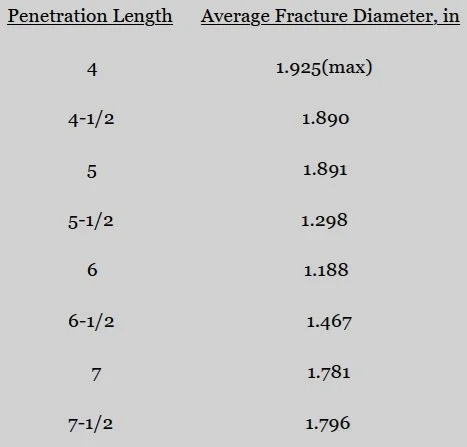
The interpreted reason for the average fracture diameter decreasing at five inches is the jacket and core material comprising the mushroom that was initially formed was stripped away (spalled) and its diameter reduced because its end area could not withstand the drag shear stress imposed by the gel. Bullet material being stripped away from the mushroom was launched radially away from the bullet’s travel direction, as indicated by the lead-core shrapnel shard visible at about seven inches of penetration.
These gel-slice measurements also indicate that the drag force imposed by the gel began to re-form the bullet’s mushroom beyond about six inches, as shown by the average fracture measurements tabulated above. However, Photo 5 shows the bullet continued to spall shrapnel-sized shards after this mushroom re-formation, as shards are visible at about 9-3/4, 10, 10-1/2, 11-1/4, 12-1/4, and 13-1/2 inches. These shards indicate the mushroom was likely experiencing changes in its diameter during its re-formation process.
These mushroom-spalling and mushroom-re-forming cycles indicate the bullet’s mushroom diameter was not uniform as it passed through the gel, and varied to an unknown degree along its penetration length. These gel-test data demonstrate a retained bullet’s mushroom diameter may not accurately characterize its diameter throughout its penetration length, and a simple cylinder with a uniform diameter may not accurately represent the volume that was produced.
Another fundamental assumption embedded in judging an expanding hunting bullet’s likely field wounding capability from its tested mushroom diameter is the average measured diameter produces a unique wound-volume magnitude that is representative for any impact velocity. However, published synthetic gel-test data where both a retained bullet’s mushroom diameter and its attendant wound volume have been measured for one bullet at various impact velocities indicate the same mushroom diameter can be produced at two different impact velocities. The test data show the same mushroom diameter produced 3.3 times more measured wound volume in the gel at the higher impact velocity. The entire test-data set clearly shows that an expanding hunting bullet’s retained mushroom diameter depends on its impact velocity and generic design, and is not an indicator of a unique test-determined wound volume. The testing process and the published data that justify this conclusion are explained in a two-part article on this website, with part one found here.
The wound volume produced by a bullet recovered from a big-game animal is also typically judged based on the retained bullet’s mushroom shape and average diameter. The visual appearance factors previously discussed for tested bullets are also frequently used. Large circular mushrooms are assumed to have produced large wound volumes; small/marginal non-circular mushrooms are assumed to have produced small wound volumes. As with judging a mushroom of a bullet retained in test media, there can be limited-to-no recognition that the mushroom of a bullet recovered from an animal may or may not represent its configuration throughout its penetration journey. Wound measurements are not typically performed to corroborate/validate wounding judgements based on mushroom configuration and diameter.
Field wound-volume determinations were made during skinning-shed autopsies performed on the 2023 management hunt. Comparison of the average retained-bullet mushroom diameters to actual wound volumes indicates there is no relationship between the average mushroom diameter of a mushroom retrieved from and animal and the wound volume produced. Furthermore, these field data indicate the average mushroom diameter obtained from testing can also misrepresent the wound volume magnitude actually produced. The following example using data from the management hunt illustrates these issues.
Photo 8 shows 200-grain Woodleigh Weldcore (200 WWC) bullets recovered from either 20% synthetic gel or from zebras on the management hunt. Subjectively, the mushroom on the test bullet is large and essentially round. Simply based on how the test mushroom “looks”, most hunters would judge that this bullet would be capable of producing a large wound volume.
The test bullet’s mushroom also creates the expectation that the mushroom on a 200 WWC recovered from an animal will be similar. Any recovered bullet’s mushroom that doesn’t subjectively resemble the test bullet’s will likely be a disappointment. “Mushroom mangling” that results in progressively non-circular, smaller-diameter mushroom cross-sections will likely result in progressive degrees of disappointment, potentially leading to a judgement of “bait-and-switch” betrayal. Any degree of disappointment in the recovered bullet’s mushroom appearance could (and likely will) result in an unfavorable judgement of the bullet’s field performance, with the expectation that the actual wound volume is less than implied by the test mushroom.
The bullet recovered from Z-7 has “feel-good” associated with its appearance. The mushroom can be considered “poster-child” perfect, and is essentially a clone of the test bullet. Based on its appearance, the judgement about the expected wound volume produced would likely be in terms such as “excellent”, “large”, and “extensive”. When viewed in the context of a field wound-volume competition among the animal-recovered bullets, the likely judgement would be that the bullet from Z-7 is the winner, producing the largest field wound volume.
The appearance of Z-8’s mushroom is likely several subjective notches down from “feel-good”. Although the average mushroom diameter is substantial (only about 10% less than the test bullet’s), it is oval-shaped and “warped” to the point it is unable to stand on its shank. Furthermore, the mushroom’s surface has a divot that could potentially indicate an intact plug of lead core has been sheared away. Based on the mushroom’s appearance, the judgement about the wound volume produced would likely use terms that were less-positive than the ones used for Z-7, such as “OK”, “good enough”, and “satisfactory”. When viewed in the context of a field wound-volume competition, the likely judgement would be that this bullet finished second.
The appearance of Z-1’s mushroom could likely be described as “butt-ugly.” The mushroom is oval-shaped and has a “puny” average diameter compared to the test bullet’s (about 41% less). Like Z-8’s, the mushroom’s surface has a divot that could potentially indicate an intact plug of lead core has been sheared away. Even though the bullet is standing on its shank, its appearance could lead some hunters to conclude the bullet has catastrophically failed. Based on the mushroom’s appearance, judgements about the wound volume produced would likely include the uncomplimentary terms of “poor”, “bad”, and “unsatisfactory”. When viewed in the context of a field wound-volume competition, the likely judgement would be that this bullet finished “dead-last” (instead of 3 rd ), with some hunters adding the qualifier of “not even close”.
The total bullet-hole wound volumes through both lungs and the heart were determined for each zebra, as tabulated below:
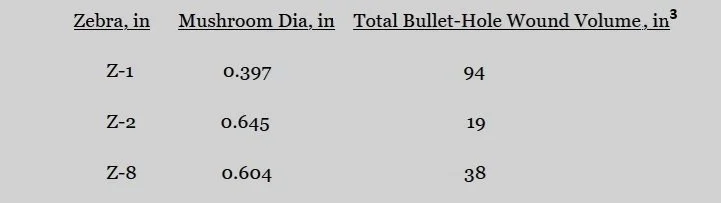
Based on actual wound-volume magnitudes, the bullet with the worst average mushroom diameter had the best total bullet-hole wound volume. Stated another way, the bullet with the “butt-ugly” mushroom had almost five times more wound volume than the one with the “picture-perfect” mushroom. The “short-version” reason for this difference is skinning-shed observations of Z-1’s thoracic cavity and the actual wounding produced in both lungs and the heart indicated breaching nearside rib bones and the spine caused considerable bullet tumbling, significantly increasing the bullet-hole diameter well beyond its test mushroom diameter.
As discussed in this article, gel testing has shown that a bullet’s retained mushroom diameter is not uniquely related to a wound volume, and it may not accurately represent its diameter or the actual bullet hole throughout the bullet’s penetration length. Furthermore, a bullet’s penetration through an animal can introduce factors such as tumbling and weight-loss shrapnel (refer to section 12.6 on page 51 of the 2023 management hunt report) that can cause wounding far more extensive than the wounding implied by a retained bullet’s mushroom diameter. Such factors indicate field-performance judgements about any expanding hunting bullet should be made based on actual wounding damage produced by the bullet, not the bullet damage produced by the wounding.
The 200 WWC’s mushroom and wound data underscore how the terminal-performance perception and reality issues can interact when a bullet’s mushroom diameter is used to evaluate either likely wounding based on testing or actual wounding based on autopsy data. With either evaluation, using a retained bullet’s mushroom diameter to make wound-volume judgements can be misleading-to-totally incorrect.
The relative magnitude of the actual field wound volume produced by an expanding hunting bullet can be empirically determined by analyzing the fractures produced by testing in 20% synthetic gel rather than by the bullet’s mushroom produced by the test. The testing and analytical methods are discussed in an article found here.